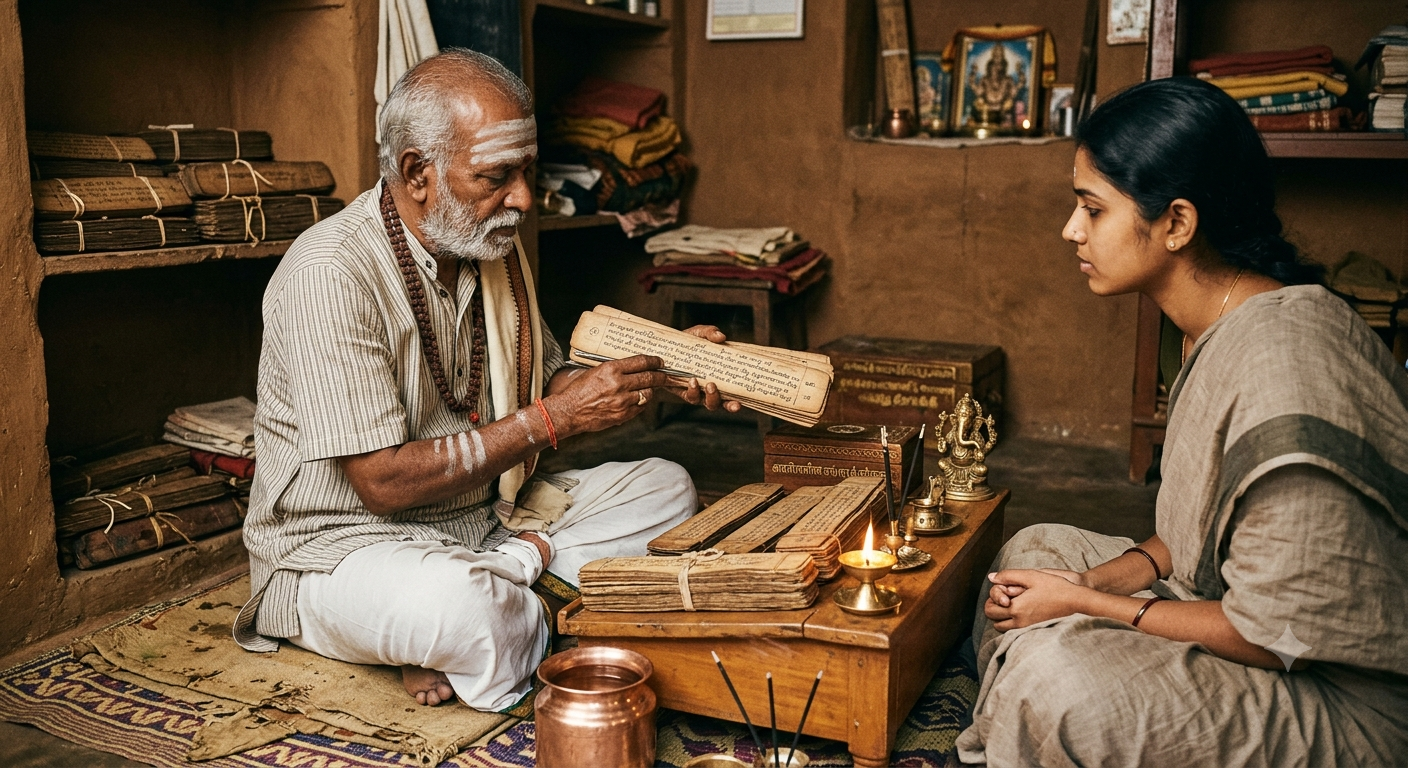
Nadi Astrology is an ancient Indian spiritual tradition associated with palm leaf manuscripts that are believed to contain records about the lives of individuals. The practice is especially connected with Tamil Nadu and places such as Vaitheeswaran Koil, where traditional Nadi readers have preserved and interpreted palm leaf manuscripts for generations.
For a beginner, Nadi Astrology can seem mysterious because its process is different from a standard horoscope or birth-chart consultation. A traditional Nadi reading may involve a thumb impression, classification of palm leaves, identification questions, and the reading of an ancient manuscript said to correspond with the seeker.
This beginner’s guide explains the basic ideas, traditional process, history, palm leaf identification method, chapters, remedies, online consultation process, and important points to understand before attending a Nadi Astrology reading.
What Is Nadi Astrology?
Nadi Astrology, also called Nadi Jyothidam or Palm Leaf Astrology, is a traditional system of divination found mainly in South India. According to the tradition, ancient sages or Siddhars recorded information about the lives of certain individuals on palm leaves many centuries ago.
Different Nadi traditions are associated with revered sages such as Agasthiyar, Suka, Kousika and other Siddhars.
The palm leaf manuscripts may contain descriptions relating to different areas of life, including:
- Family and relationships
- Marriage
- Education
- Career and profession
- Financial matters
- Children
- Spiritual development
- Travel
- General life experiences
- Traditional remedies or spiritual practices
Nadi Astrology belongs to a religious and cultural tradition. Its predictions and spiritual claims have not been scientifically established, so it is best approached as a traditional spiritual practice rather than a substitute for professional medical, legal or financial advice.
What Is a Nadi Palm Leaf?
Palm leaves were widely used as writing material in ancient and medieval South India. After being prepared and dried, information could be inscribed onto the surface using a stylus.
Traditional Nadi manuscripts are generally written in older Tamil scripts or poetic forms that may be difficult for modern readers to understand directly.
A Nadi astrologer is traditionally trained to read, interpret and explain the verses contained in these manuscripts.
Because individual leaves may become damaged over time, some traditional collections have been copied or recopied by later generations in order to preserve their contents.
Who Was Agasthiyar?
Agasthiyar, also known as Sage Agastya, holds an important position in South Indian spiritual traditions. He is widely associated with Tamil Siddha philosophy, traditional knowledge and several spiritual practices.
One of the most recognized branches of Nadi Astrology is known as Agasthiya Nadi Astrology.
According to traditional belief, Sage Agasthiyar possessed extraordinary spiritual insight and recorded information concerning the lives and karmic journeys of future individuals.
For this reason, many people searching for authentic Nadi Astrology specifically look for Agasthiya Nadi or Agasthiyar Palm Leaf Reading.
Why Is the Thumb Impression Important in Nadi Astrology?
One of the most distinctive parts of a traditional Nadi Astrology consultation is the use of the seeker’s thumb impression.
Traditionally:
Men provide the right thumb impression.
Women provide the left thumb impression.
The thumb impression is classified according to traditional patterns. The classification is then used to identify a particular bundle of palm leaves from the manuscript collection.
The thumb impression does not immediately identify one exact leaf. Instead, it is traditionally used as a starting point to narrow the search to a group or bundle of manuscripts.
How Is Your Nadi Palm Leaf Identified?
Finding the appropriate palm leaf is one of the most interesting parts of a Nadi reading.
After selecting a bundle based on the thumb impression, the Nadi reader may begin reading statements from different leaves.
Instead of immediately asking the seeker to provide complete personal information, the reader traditionally asks confirmation questions.
For example, statements may relate to:
- Family structure
- Number of siblings
- Parents
- Marital status
- Occupation
- Personal circumstances
- General life details
The seeker normally responds with simple answers such as yes or no.
If several statements do not correspond, that leaf may be rejected and another leaf is examined.
This process continues until the reader believes the correct palm leaf has been identified.
What Happens After the Correct Palm Leaf Is Found?
Once a matching leaf is identified, the main reading usually begins.
The astrologer may first read a general section traditionally known as the General Kandam or general chapter.
This section may contain information concerning the seeker’s identity and major aspects of life.
Depending on the manuscript tradition, the reading may discuss subjects such as family circumstances, personality, career, relationships and future periods.
The original verses are generally read in Tamil and then explained in a language understood by the seeker.
Some centres also provide a voice recording, written notes or translated explanations.
What Are the Different Kandams in Nadi Astrology?
Nadi manuscripts are traditionally divided into different sections known as Kandams or chapters.
Each chapter is associated with a specific area of life.
General Kandam
The General Kandam provides an overall introduction to the individual’s life and is usually the first chapter read after identification.
Marriage Kandam
This chapter traditionally concerns marriage, relationships, characteristics of a future spouse and possible marriage periods.
Career Kandam
The career chapter may discuss profession, employment, business opportunities, professional changes and work-related periods.
Education Kandam
This section may focus on studies, educational direction and learning opportunities.
Children Kandam
This chapter traditionally discusses matters related to children and family expansion.
Finance Kandam
Some readings may contain information relating to wealth, income, property or general financial circumstances.
Spiritual or Remedy Kandam
Certain chapters may discuss spiritual development, karmic themes or traditional remedial practices.
The exact organization and numbering of chapters can vary between different Nadi manuscript traditions.
What Are Nadi Astrology Remedies?
Traditional Nadi readings sometimes recommend Pariharam, meaning a spiritual or religious remedy.
These remedies are generally connected with the belief that certain difficulties in life may relate to past actions or karmic influences.
Suggested traditional practices may include:
- Temple worship
- Prayer
- Charity
- Feeding people or animals
- Lighting lamps
- Reciting mantras
- Performing specific religious rituals
- Visiting particular sacred places
A genuine spiritual consultation should never pressure someone into expensive rituals or guarantee miraculous results.
Remedies should be treated as voluntary religious or spiritual practices.
What Is Vaitheeswaran Koil’s Connection With Nadi Astrology?
Vaitheeswaran Koil is one of the locations most closely associated with Nadi Astrology.
The town is located in Tamil Nadu and is also famous for the ancient Vaitheeswaran Temple.
For generations, families of traditional Nadi readers in and around Vaitheeswaran Koil have maintained collections of palm leaf manuscripts.
As a result, people from different parts of India and other countries travel to the region seeking Nadi Palm Leaf Reading.
The terms Vaitheeswaran Koil Nadi Astrology, Agasthiya Nadi Astrology and Palm Leaf Reading are therefore often closely connected.
Can Nadi Astrology Be Done Online?
Today, some Nadi Astrology centres provide online consultations for people who cannot travel to Tamil Nadu.
An online Nadi reading may involve sending a clear image of the required thumb impression.
The reader may then search the corresponding manuscript bundles and conduct the identification process through a phone call or video consultation.
If the leaf is identified, the reading can be explained remotely.
Some centres also provide recorded audio or written summaries after the consultation.
The basic traditional method may therefore remain similar, while modern communication technology allows the consultation to take place from another city or country.
How Should a Beginner Prepare for a Nadi Reading?
A first-time seeker does not need extensive preparation.
It is useful to approach the consultation with patience because searching for a matching leaf may take time.
During the identification stage, listen carefully to the statements and answer accurately.
Avoid giving unnecessary personal information before the identification process if you want to experience the traditional matching method.
It is also sensible to ask the centre beforehand about consultation charges, the number of chapters included and whether recordings or translations are provided.
How to Choose a Nadi Astrology Centre
Before booking a consultation, research the practitioner or centre carefully.
Look for clear information about the reading process, location, consultation charges and services.
Avoid practitioners who promise guaranteed wealth, guaranteed marriage, guaranteed medical cures or other impossible outcomes.
A professional Nadi reader should explain the traditional process respectfully and allow the seeker to make independent decisions.
Reviews and recommendations may provide useful background, but they should not be the only factor when choosing a reader.
Nadi Astrology vs Regular Horoscope Astrology
Traditional horoscope astrology normally begins with details such as a person’s date, time and place of birth.
Nadi Astrology follows a different process.
In many Nadi traditions, the search starts with the thumb impression rather than the birth chart.
After the appropriate leaf is believed to have been located, the manuscript may contain birth-related information and life descriptions.
This palm leaf identification process is one of the main characteristics that distinguishes Nadi Astrology from conventional horoscope consultations.
Final Thoughts
Nadi Astrology and Palm Leaf Reading represent a fascinating part of South India’s spiritual and manuscript heritage.
For believers, the experience may offer spiritual reflection, guidance and a unique connection with an ancient tradition. For others, it may simply be an opportunity to explore an unusual cultural practice preserved across generations.
A beginner should approach Nadi Astrology with curiosity, patience and realistic expectations.
Understanding the thumb impression method, palm leaf identification process, Kandams, traditional remedies and the role of places such as Vaitheeswaran Koil can help you make a more informed decision before arranging a consultation.
Whether you visit a traditional Nadi Astrology centre personally or choose an online Palm Leaf Reading, the most important step is selecting a practitioner who clearly explains the process, respects your choices and represents the tradition responsibly.